Beverley and Barmston Drain
Bridlington Avenue Cycleway
Local Heritage
Stepney Lane Bridge
Stepney Lane ends at a narrow rural-style arched brick bridge with low parapets. It is not a through route and only gives access to a private house and private land originally used for agriculture, then allotments. It has never been widened, and probably shows the original design of the early bridges elsewhere along the drain that have since been upgraded for highway use.
Railway Heritage
Hull, Barnsley & Railway
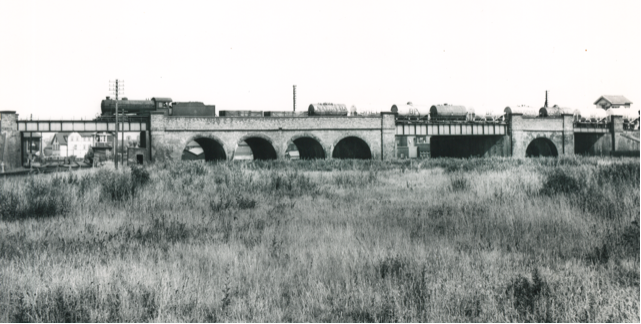
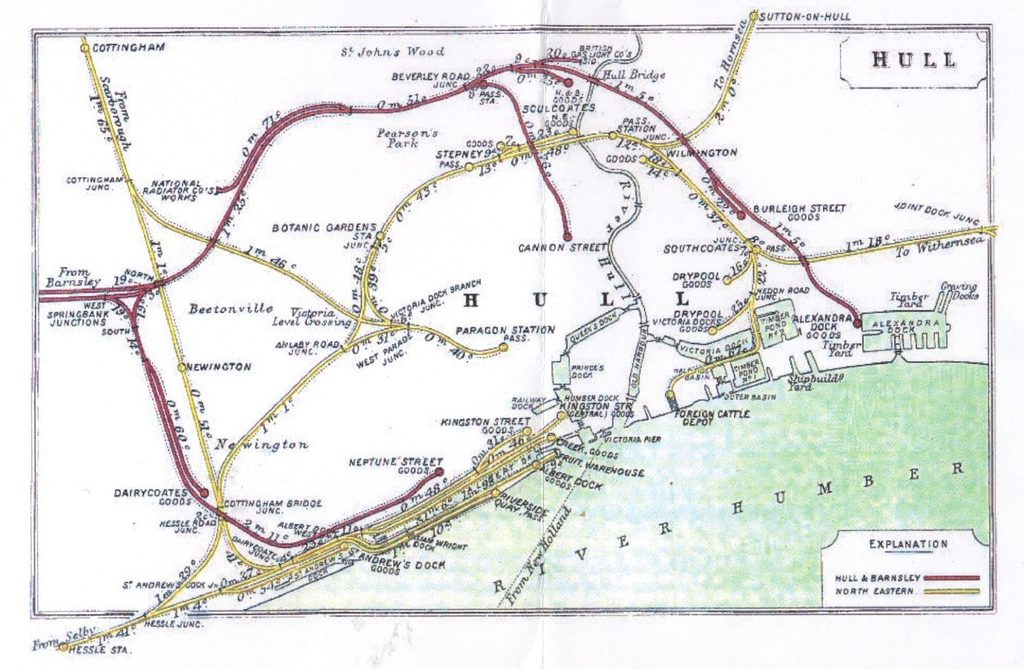
The raised ground alongside the drain here, used to carry the tracks of the Hull, Barnsley & Railway which was one of the last large scale railway companies to be created in 19th century England. It was built at a cost of almost £6 million and was designed to break the monopoly of the North-Eastern Railway (NER) which connected the rival towns of Goole and Grimsby. The railway company also built the Alexandra Dock especially for exporting coal and they were both operational on the 27th July 1885.
The line included a branch that delivered coal directly to Sculcoates power station and delivered passengers to a station on Cannon Street.
Because it was built after the other railways, the line had to be elevated onto a high level to avoid the need for level crossings where roads and other rail tracks were already in exisitence. It crossed the now disused Victoria Dock line close to Stepney Lane. The old Stepney Lane station building can still be seen next to Beverley Road.
Railway History
From Railway to Green Space
After 37 years of independence, it was eventually absorbed by the NER on the 1st April 1922 and becoming part of the larger London and North-Eastern Railway (LNER) following the Railway Act. In 1924 Cannon Street closed to passengers, after the LNER opened the Hull Paragon station and passenger services were diverted here. In 1968 the Cannon Street station closed completely, and the tracks were removed.
The raise embankments are now overgrown and have become important green spaces and wildlife areas, while the station itself has been replaced by part of the Hull College campus.
Project Partners
Hull’s Dynamic Drains is led by the Environment Agency and delivered in partnership with Hull City Council , Groundwork Yorkshire and Yorkshire Wildlife Trust .