Hull’s Dynamic Drains
Holderness Road
Discover the history of Holderness Road, from its early rural surroundings and horse-drawn transport to the changing landscape of East Hull and the development of the road we see today.
Holderness Drain locations
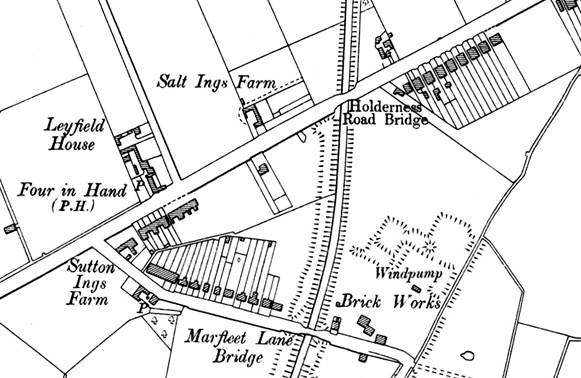
This point marks where the original old Holderness Road was carried over the Holderness Drain, at first by a narrow bridge, as seen on the 1890 map shown here.
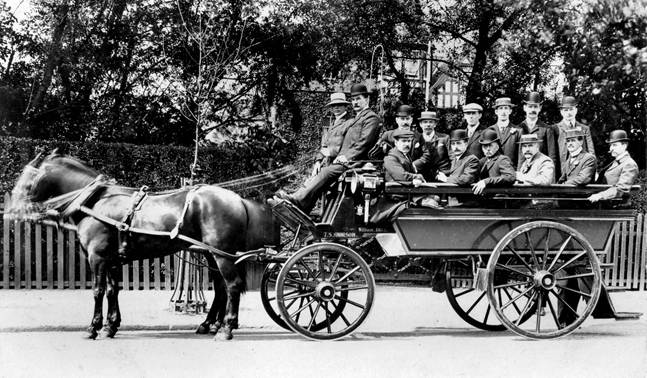
It’s hard now to imagine a time when all our daily requirements were delivered by horse drawn vehicles, and the general public rarely strayed further than a few miles from their homes. This very rural part of the Holderness Road would have been served by wagonettes such as the one seen here, on the Holderness Road, but these would have been very infrequent. The wealthier homes would have their own cart or gig, but the working classes would rarely travel far.
This was the situation until the advent of motor buses in the 1930s, that occasionally ran along Holderness Road to the hospital at Sutton Annexe, or the eastern villages. The tram network never came this far – running only as far as the city terminus at Ings Road (extended there from Aberdeen street in 1925). Beyond the tram terminus it was horse-drawn transport and then small motor buses, until the regular bus service arrived. As the bus services were originally very sparse, often just early or late buses for the workers, much of the daily goods were delivered by van well into the 1960s.
Just to the west of this information board, heading towards Hull, is the Four In Hand pub. This was originally known as The Four Alls, which was first mentioned by name in the records in 1840, although it may have been slightly older. During the 1840s the landlord was Richard Baxter, listed in 1848 as a corn miller and victualler, Four Alls, Holderness Road. Alongside the old pub was Baxter’s large corn windmill, as well as several related buildings. He probably established the pub to supplement his income.
Taking its trade from the mills, brick works, farms and sporadic housing in the area, the pub became popular – as the next nearest inns were a distance away in Sutton or the other villages. The pub sign for this name was usually made up of four panels – the first showing the King or Queen (I rule all), a Parson (I pray for all), a Soldier (I fight for all) and the last a picture of a working-class man (I pay for all). During the 1880s the Hull Harriers running club ran from here, and in the 1890s it was home to several ‘pigeon flying’ teams. Late in 1889 the pub was referred to as the Four In Hand for the first time in the newspapers, the new name referring to a team of four horses used to pull heavier vehicles.
Alongside the pub was Sutton Lane, also known as Four Alls Lane. This was re-named Bellfield Avenue c.1926. Part of the suburban development that included Bellfield Avenue was for a new and larger Four In Hand Hotel. It was nearing completion in May 1937, one of three ‘new’ pubs planned for East Hull (the Lambwath and the Ganstead being the others). This is the pub we see today, still trading after 185 years.
On 22 June 1937 (at 2 pm) an auction of the old: ‘Public House Fixtures, Fittings, Trade Utensils Etc’, was held at the newly built pub, the notice informing readers that: ‘the new house opens 11 am this day!’ A later article in July 1937 informed that the old inn sign had been presented to the Wilberforce House Museum, for the ‘old street’ there. The image shown here dates from c.1937, just before demolition of the old pub.
It was during the late 1930s that the Holderness Road was widened here and the old narrow bridge over the drain here was removed and the road made a dual carriageway.
Explore Holderness Drain
Project Partners
Hull’s Dynamic Drains is led by the Environment Agency and delivered in partnership with Hull City Council , Groundwork Yorkshire and Yorkshire Wildlife Trust .
Holderness Road
This point marks where the original old Holderness Road was carried over the Holderness Drain, at first by a narrow bridge, as seen on the 1890 map shown here.
It’s hard now to imagine a time when all our daily requirements were delivered by horse drawn vehicles, and the general public rarely strayed further than a few miles from their homes. This very rural part of the Holderness Road would have been served by wagonettes such as the one seen here, on the Holderness Road, but these would have been very infrequent. The wealthier homes would have their own cart or gig, but the working classes would rarely travel far.
This was the situation until the advent of motor buses in the 1930s, that occasionally ran along Holderness Road to the hospital at Sutton Annexe, or the eastern villages. The tram network never came this far – running only as far as the city terminus at Ings Road (extended there from Aberdeen street in 1925). Beyond the tram terminus it was horse-drawn transport and then small motor buses, until the regular bus service arrived. As the bus services were originally very sparse, often just early or late buses for the workers, much of the daily goods were delivered by van well into the 1960s.
Wagonette built by Annison’s of Witham c.1910
Just to the west of this information board, heading towards Hull, is the Four In Hand pub. This was originally known as The Four Alls, which was first mentioned by name in the records in 1840, although it may have been slightly older. During the 1840s the landlord was Richard Baxter, listed in 1848 as a corn miller and victualler, Four Alls, Holderness Road. Alongside the old pub was Baxter’s large corn windmill, as well as several related buildings. He probably established the pub to supplement his income.
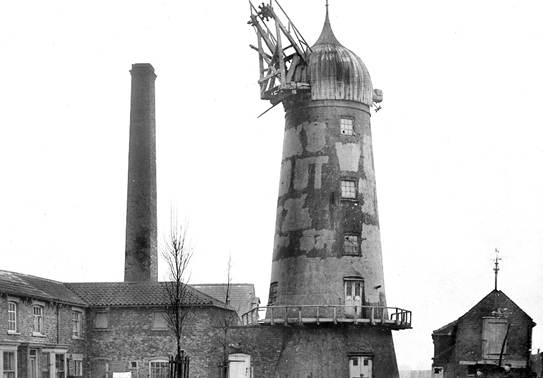
Shown here is another old corn mill that faced Holderness Road, showing how the Four All’s mill would have appeared. This was Eyre’s Mill, now converted to be The Mill pub.
Taking its trade from the mills, brick works, farms and sporadic housing in the area, the pub became popular – as the next nearest inns were a distance away in Sutton or the other villages. The pub sign for this name was usually made up of four panels – the first showing the King or Queen (I rule all), a Parson (I pray for all), a Soldier (I fight for all) and the last a picture of a working-class man (I pay for all). During the 1880s the Hull Harriers running club ran from here, and in the 1890s it was home to several ‘pigeon flying’ teams. Late in 1889 the pub was referred to as the Four In Hand for the first time in the newspapers, the new name referring to a team of four horses used to pull heavier vehicles.
Alongside the pub was Sutton Lane, also known as Four Alls Lane. This was re-named Bellfield Avenue c.1926. Part of the suburban development that included Bellfield Avenue was for a new and larger Four In Hand Hotel. It was nearing completion in May 1937, one of three ‘new’ pubs planned for East Hull (the Lambwath and the Ganstead being the others). This is the pub we see today, still trading after 185 years.
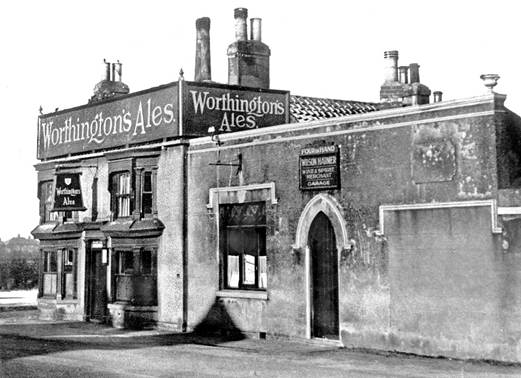
On 22 June 1937 (at 2 pm) an auction of the old: ‘Public House Fixtures, Fittings, Trade Utensils Etc’, was held at the newly built pub, the notice informing readers that: ‘the new house opens 11 am this day!’ A later article in July 1937 informed that the old inn sign had been presented to the Wilberforce House Museum, for the ‘old street’ there. The image shown here dates from c.1937, just before demolition of the old pub.
The old Four Alls / Four In Hand pub, shown in 1937 shortly before demolition.
It was during the late 1930s that the Holderness Road was widened here and the old narrow bridge over the drain here was removed and the road made a dual carriageway.