Hull’s Dynamic Drains
Hedon Road
Discover the history of the buildings, institutions and communities that developed alongside the Holderness Drain and Hedon Road.
Holderness Drain locations
Maternity Hospital
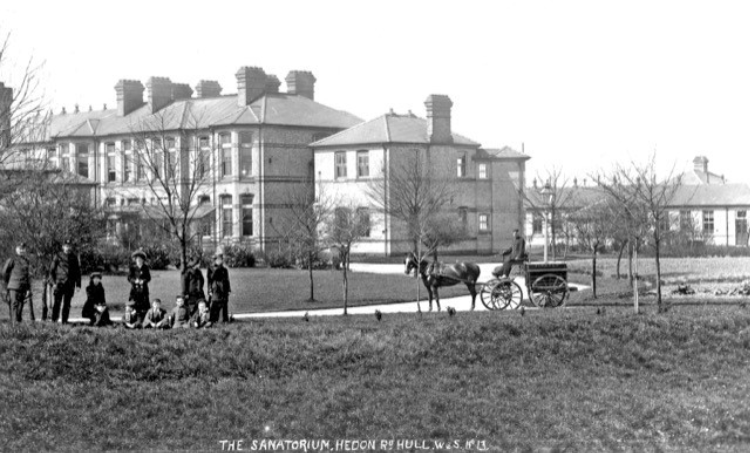
What locals remember fondly as the Hedon Road Maternity Hospital was first established as the City Hospital for Infectious Diseases, located immediately west of the Holderness Drain. It opened in 1886, and was extended in 1889, and again in the early 1900s.
Often referred to by the old term Sanitorium, or the City Fever Hospital, the Infectious Diseases Hospital moved to a new site at Castle Hill (now the much-extended Castle Hill Hospital) in Cottingham in 1928, and the Hedon Road site became the Hull Maternity Hospital in 1929 – the Maternity Hospital having spent five years on the Castle Hill site prior.
It was well equipped for the time, with two labour lifts, two receiving wards and an operating theatre. It had 83 beds, including 49 for maternity as well as 10 isolation beds.
The Hedon Road Maternity Hospital was demolished in 2003, following the opening of the Hull Women & Children’s Hospital on Anlaby Road in 2002, and the site is planned to be a ‘state-of-the-art industrial, manufacturing and logistics hub’ to be called Kingston Parklands. This is being developed by J. R. Rix & Sons, who acquired the site in 2019.
Cemetery / Columbarium
To the west of the City Hospital site is the Hedon Road cemetery, built on a 15-acre plot in 1873. The original entrance gates, pillars and lodge survive, but two ornate mortuary chapels 100 yards within the gates (one non-conformist and one Church of England) joined by a grand tower with arched entrance beneath, were damaged beyond repair during the Second World War and never replaced.
A further eight acres were acquired behind the hospital in 1894, where a purpose-built crematorium with chapel was opened in 1901; the first municipal crematorium to be built in the country.
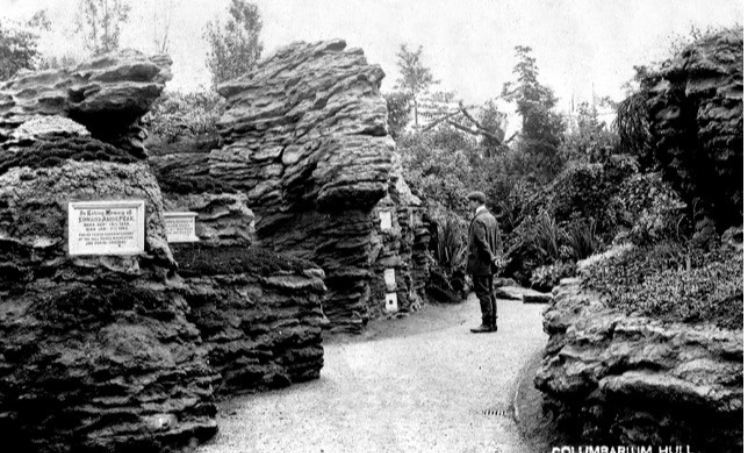
Part of the facility was a columbarium, where graves are stacked in niches, vertically, within mock-stone rockery surrounds. The crematorium became disused in 1961 when a new facility opened on Chanterlands Avenue.
The chapel, crematorium, and columbarium were given Grade II Listed Building status and protection in 1994.
Prison
Hull’s first ‘Gaol’, a four-storey tower, stood at the south end of the Market Place and was in use from the 14th Century. It was deemed ‘insufficient’ by the 1780s and a new building was created in Castle Street. In turn this was replaced by a much larger building in Kingston Street, which opened in 1823.
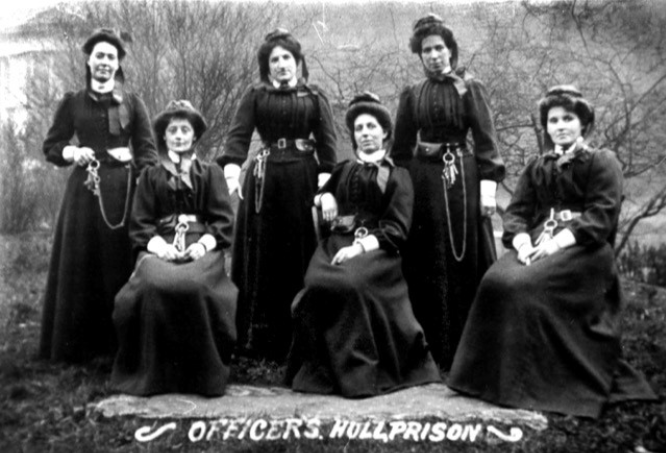
The present prison on the Hedon Road, immediately to the west of the cemetery, was begun in 1865 on a 12-acre plot, designed by David Thorp the borough surveyor, who died before its completion in 1870.
The main body of the prison is in the form of a cross, designed in the panopticon plan, whereby one officer in the right location could see along several blocks. Other buildings on site included a chapel and an Italianate style house for the prison governor, and later a mortuary and an infirmary.
A pleasant courtyard was available for exercise, although prisoners were kept busy at work that included making fish boxes and gas masks, sugar-breaking, and making castings for other prisons in an on-site foundry.
From 1939 the building was used as a Military Prison and later a Civil Defence Depot, re-opening as a borstal in 1950, after repairs to extensive bomb-damage sustained during the Second World War.
In 1969 Hull became one of England’s first maximum security prisons with a capacity of 1,000 by 2006.
The site was enlarged in 2002 taking in land at the rear where four new wings, a health care centre, a sports hall, and ‘multi-faith centre’ were constructed as well as refurbishment to other part of the prison including the kitchen, education block and workshops. The frontage was much altered in 2008.
Changing landscape
Hedon Road through time
From hospitals and cemeteries to prisons and modern redevelopment, the land alongside Hedon Road has continually changed while retaining important traces of Hull’s history.
Explore Holderness Drain
Project Partners
Hull’s Dynamic Drains is led by the Environment Agency and delivered in partnership with Hull City Council , Groundwork Yorkshire and Yorkshire Wildlife Trust .