Holderness Road • East Hull
Portobello Street
Portobello Street was part of a huge house-building programme that occurred in the 1890s around the rapidly developing Holderness Road.
Holderness Drain locations
A changing landscape
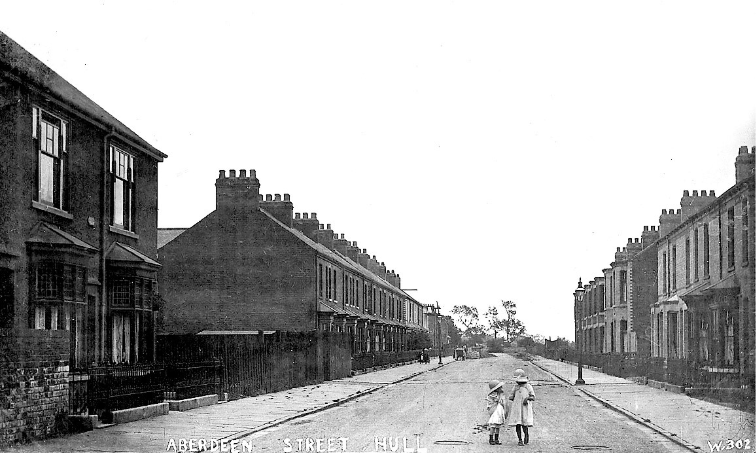
Portobello Street was part of a huge house-building programme that occurred in the 1890s around the rapidly developing Holderness Road. It was constructed in 1891 by the Holderness Industrial and Provident Land Society Ltd., and it appears street names in this area had a Scottish theme. Porto Bello is a seaside resort in Scotland, and fronting Holderness Road nearby is a row of 14 houses named Argyle Parade. Aberdeen Street, another Scottish town name, is nearby and was developed at the same time.
Argyle Parade, was a symmetrical terrace of 14 houses, built on the north side of the Holderness Road c.1905. At that time the Holderness Road was only just developing beyond this point, except for some windmills and a few older houses here and there, and the road itself was still little more than a dirt track.
As the road developed further east, many of these houses became shops to serve the new community and a cinema was built at the west end of the terrace. Opening in 1934, the Astoria cinema required the demolition of the first house in the terrace. The cinema was later converted to a bingo hall.
New housing and transport
Thriving new area of housing with a huge population demanded new facilities, and the workforce that lived in the houses needed readily available transport to get to work and the town centre.
In 1902-03 the original highway of Holderness Road was transformed into a ‘dual carriageway’ beyond the Crown Inn, to accommodate a tramway extension to Aberdeen Street; previously, the Holderness Road trams terminated at the Crown Inn near Summergangs Road.
At this time the trams ran along the middle of what is now the grass verge between the east and westbound roads.
Several notable buildings were built along this section of the Holderness High Road during the 1920s and 1930s, including the Astoria Cinema, the old William Jackson’s store at the corner of Southcoates Avenue, and the ‘new’ Crown Inn, which was rebuilt in 1938 in the vaguely Art Deco ‘cinema style’ of architecture that we see it today.
Scottish street names
As Portobello Street was extended from the 1930s onwards, other new developments kept with the theme; Oban Street/Avenue took their name(s) from another Scottish resort, Lismore Grove is named after an island in Scotland, and Seafield Avenue is named after an area in Scotland.
Tramways and industry
The terminus of the tram system at Aberdeen Street required the construction of the Holderness Road tramcar depot, almost a duplicate of the shed constructed on Hedon Road.
Opened in 1903, it replaced an earlier depot opposite the old Crown Inn at Lee Street. Tram service only ran to Lee Street until 1903 when it was extended to the new terminus to serve the massive increase in housing in the area.
Tragically, the beautiful building was hurriedly demolished following a suspicious fire in May 1988, preventing an ongoing attempt to make it a Listed Building. The site is now lost beneath the entrance to the Morrison’s supermarket.
Changing landscape
Portobello Street
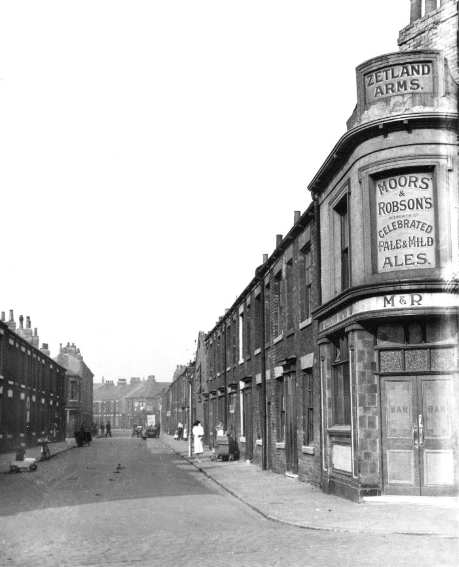
From the early house-building programme of the 1890s and the development of Scottish-themed streets, Portobello Street and the surrounding area became an important part of the rapidly expanding eastern suburbs of Hull.
Explore Holderness Drain
Project Partners
Hull’s Dynamic Drains is led by the Environment Agency and delivered in partnership with Hull City Council , Groundwork Yorkshire and Yorkshire Wildlife Trust .